Is Lima Safe? An Honest Guide for Travelers in 2026
Lima is safer than the headlines suggest, and more nuanced than the reassuring guides admit. Here's the honest answer, by neighborhood, with the practical tips that work.
Is Lima Safe? An Honest Guide for Travelers in 2026
This is the question we get more than any other. It's also the question most travel guides answer badly — either with anxious lists of every possible risk that scare you out of coming, or with reassuring platitudes that ignore the parts of Lima that are genuinely worth avoiding. Neither is helpful when you're booking a flight.
The honest answer is this: Lima is a major Latin American capital of 10 million people, and it has the safety profile that comes with that. The neighborhoods where 99% of tourists spend their time — Miraflores, Barranco, San Isidro — are as safe as any major European or North American city, day and night. The neighborhoods where serious crime concentrates are ones you have no reason to visit, that no tour company goes to, and that most Limeños themselves avoid. Knowing which is which is most of the safety conversation.
This guide is the version we'd give a friend before their first visit. We've been guiding travelers across Lima since 2014, ride the Malecón at every hour of the day, and what follows is what's actually worked for us and the tens of thousands of visitors we've taken through the city.
The short answer
Yes, Lima is safe for tourists who stay in the central tourist districts (Miraflores, Barranco, San Isidro) and follow standard urban precautions. Most of the negative press travelers read about Lima refers to neighborhoods on the city's periphery — areas they would never have a reason to visit. The headline experiences (the Malecón, Parque del Amor, Bridge of Sighs, Larco Museum, Historic Center by day) are concentrated in the safest parts of the city.
The longer answer is below — by neighborhood, by activity, and by realistic risk.
Where Lima sits, internationally
To calibrate expectations: Lima is safer than Mexico City, Bogotá, and Caracas, roughly comparable to Buenos Aires and São Paulo, and less safe than Santiago de Chile or Quito. On the Numbeo Crime Index, Lima typically ranks in the moderate-to-high range — driven mainly by petty theft and traffic incidents, not violent crime against tourists.
The US State Department issues a Level 2: Exercise Increased Caution advisory for Peru — the same level as France, the UK, Italy, Germany, and Spain. It's the standard advisory for the vast majority of countries Americans visit.
The point: Lima isn't a danger zone. It's a major capital that requires standard urban awareness, like any other.
Safety by neighborhood
This is the most important section of the article. Lima's safety profile varies enormously by district — far more than most European or North American cities.
Very safe day and night
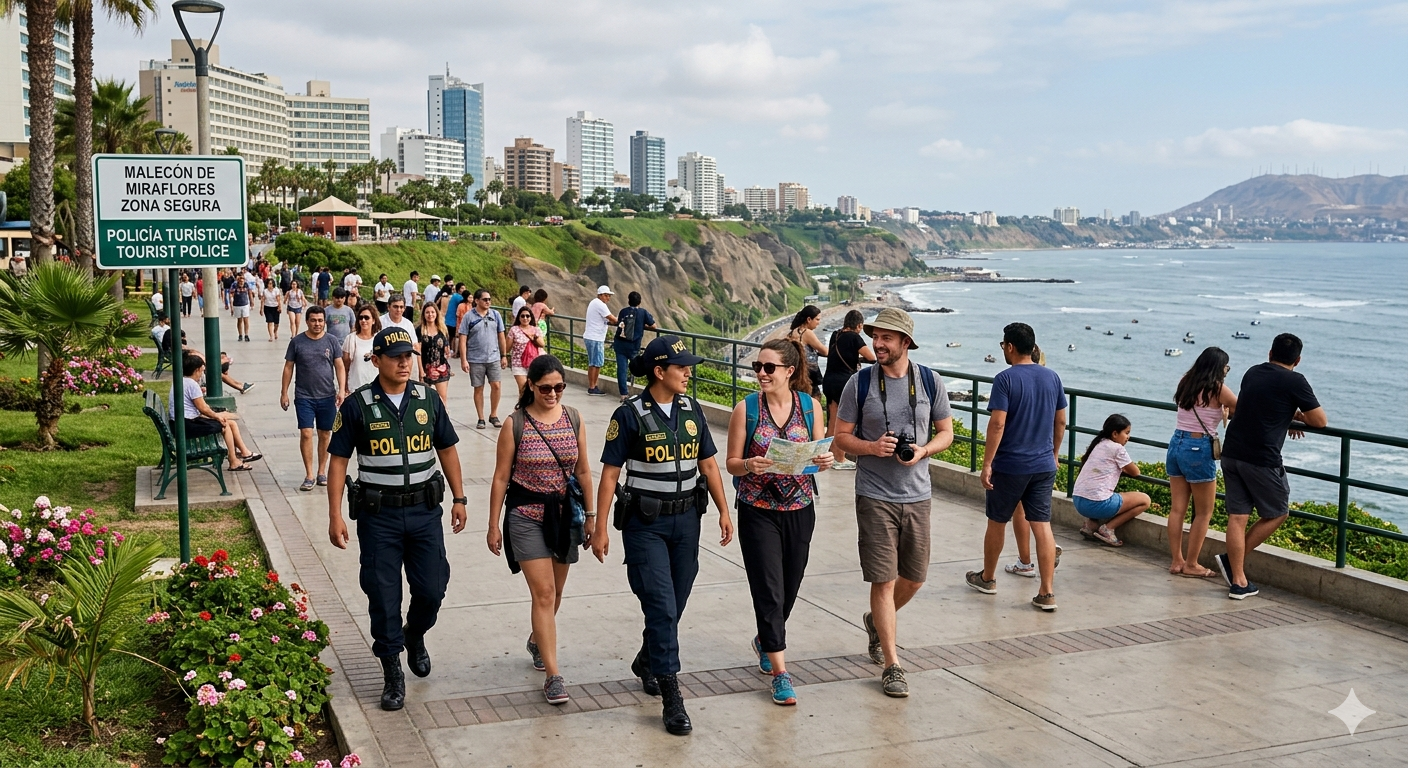
Miraflores. The most touristic district, the most policed, and statistically the safest part of Lima. Police presence is constant, the streets are well-lit, the Malecón cliff path is busy until late, and the bar district extends the natural foot traffic past midnight. You can walk this district at any hour without much thought.
San Isidro. Lima's financial and diplomatic district. Embassies, banks, and gated residential blocks. Lower foot traffic at night than Miraflores, but consistently safe. Most luxury hotels are here.
Barranco. Smaller and quieter than Miraflores, with bar-driven foot traffic until 03:00 on weekends. Day and night, central Barranco is safe. The single area to avoid in Barranco is the section near the Surco border (eastern edge of the district), which is residential and quiet but less consistently lit.
Safe by day, use Uber at night
The Historic Center (Centro Histórico de Lima). Magnificent during daylight hours — Plaza Mayor, the Cathedral, San Francisco Monastery and Catacombs, the colonial balconies. Police presence is heavy until early evening. After dark, the area empties quickly and we recommend taking Uber back to your hotel rather than walking. Most travelers visit during the day and have no need to be there after 19:00.
Pueblo Libre. The historic neighborhood where Antigua Taberna Queirolo sits and where the Larco Museum is located. Daytime: completely safe, lots of locals on the streets. Nighttime: residential and quiet — fine if you're going to a specific restaurant, but Uber rather than walking.
Surquillo. Mostly known to visitors for the Mercado de Surquillo No. 1, the food market chefs source from. Safe by day. Mixed at night — go for the market and lunch, not for the late evening.
Outside the standard tourist zones
These districts aren't dangerous to visit on a quick day trip with a guide — they're places where the casual tourist has no specific reason to be.
Callao (the port and airport district). Mixed: the airport itself and the port are heavily controlled, but parts of central Callao have higher crime rates. The exception: Callao Monumental, a small revitalized area with street art and galleries, is safe and worth visiting by day with a guide.
Chorrillos. The southern coastal district. The seafront and La Herradura beach are safe — many surfers come here daily. The interior parts of the district are mixed and not where tourists typically go.
Magdalena, San Miguel, Pueblo Libre: residential, mostly safe, but no headline tourist attractions to draw you there beyond a few specific spots.
Avoid
Comas, San Juan de Lurigancho, Villa El Salvador, Ate, Independencia: the outer districts of Lima. No tourist has a reason to be there. They sit on the urban periphery, are residential and working-class, and have higher crime rates than the central districts. They're also a 45+ minute Uber from anywhere you'd actually want to visit. If you find yourself headed there, it's almost certainly a navigation error.
The Rímac district at night. Across the river from the Historic Center, technically a tourist site (the Cerro San Cristóbal viewpoint) by day with a guide. After dark, it's the single Lima neighborhood we'd actively tell visitors to avoid.
Real risks vs imagined risks
Here's the honest breakdown of what actually happens to tourists in Lima.
What actually happens (most common)
Phone snatching. The single most frequent incident. Someone on a moped or motorcycle pulls up next to a person walking with their phone visible (texting, taking a photo, navigating with Google Maps), grabs the phone, and rides off. Prevention: don't walk with your phone in your hand on quieter streets. When you need it, stop, check it briefly, and put it away. The Malecón cliffs and busy streets are fine; the risk increases on quiet residential blocks.
Bag theft from cafés and restaurants. Slung over the back of a chair, on the floor, on the table. Distract-and-grab. Prevention: keep your bag on your lap or between your feet, with a strap looped around your ankle if it's a sit-down meal.
Taxi scams. Mostly from unregistered street taxis — inflated prices, scenic-route detours, occasional more serious incidents. Prevention: use Uber, Cabify, or InDrive exclusively. All three work well in Lima. The cost difference vs a street taxi is negligible.
Inflated prices for tourists. Markets, some restaurants, some tour operators outside the main districts. Not dangerous, just annoying. Prevention: agree on prices upfront, especially in markets.
What rarely happens (despite the headlines)
Violent crime against tourists. Statistically very rare in the central tourist districts. The high homicide and violent crime rates that appear in Peru's national statistics are concentrated in specific outer neighborhoods of Lima and in regions outside the city entirely (the VRAEM, the northern jungle). The chance of a tourist in Miraflores being a victim of violent crime is genuinely low.
Kidnapping or "express kidnapping." Almost unheard of for tourists in the central districts. Cases that do occur typically target wealthy local residents and almost never tourists.
Drug-related violence. Concentrated in specific outer districts. Tourists in Miraflores, Barranco, and San Isidro are not affected.
What's misunderstood
Protests and demonstrations. Peru has a more politically active street culture than many travelers expect — protests in central Lima, especially around the Plaza San Martín, can happen with limited warning. They're typically peaceful but can disrupt traffic and close streets. If you encounter one, walk in the other direction and continue your day. We've never seen one impact Miraflores or Barranco.
Earthquakes. Lima sits in a seismic zone. Small tremors happen several times a year and are barely noticed; major earthquakes are rare but real (the last serious one was 2007, in Pisco south of Lima). Modern hotels follow strict building codes. Know the evacuation route in your hotel and you've done the necessary preparation.
Practical safety tips that actually work
The list below is the version we give to every traveler we guide. It's short because most safety in Lima comes down to a small number of habits.
1. Use Uber, Cabify, or InDrive instead of street taxis. This single habit eliminates the most common safety issue tourists face.
2. Keep your phone out of your hand on quieter streets. Take photos, then put it away. Use offline maps if possible.
3. Don't wear obvious valuables. Watches, jewelry, expensive cameras visible around your neck. The fancier you look, the more attention you attract — not necessarily dangerous, but unnecessary.
4. Carry only what you need. A photocopy of your passport rather than the original. The amount of cash for the day, not your full reserves. Two cards in different pockets.
5. Trust your instincts on streets that feel wrong. If a street feels off, turn around. The central districts of Lima are dense and well-lit; you're rarely far from a busier street.
6. At night, take Uber rather than walk between districts. Walking the Malecón at sunset is one of the best things to do in Lima. Walking from the Historic Center back to Miraflores at midnight is not.
7. Eat ceviche only at lunch. Not a safety issue exactly — but a "Lima travel illness" that hits visitors who eat raw fish that's been sitting since noon. The locals know; now you do too.
8. Drink bottled or filtered water. Lima's tap water is technically potable but most locals filter it. Restaurants serve filtered water. Avoid ice from street vendors.
9. Have your hotel address written down in Spanish. Useful for taxi confirmation, useful in any unexpected situation. Most Uber drivers speak limited English.
10. Save the emergency numbers. 105 for police, 106 for fire, 117 for medical emergencies. Tourist Police (POLTUR): a dedicated unit for tourist-related incidents, with English-speaking officers, located in Miraflores.
Is Lima safe at night?
Yes — in the right districts. Miraflores and Barranco are safe day and night, with steady foot traffic, strong police presence, and full bar/restaurant scenes that keep the streets active. San Isidro is safe but quieter at night — fine if you're walking between specific places, but with less ambient activity than Miraflores.
The one thing we tell visitors: the cliff path along the Malecón stays busy until midnight on weekends, and is well-lit and safe to walk. The cliff parks themselves (Parque del Amor, Parque Salazar) get quiet after the sunset crowd leaves around 19:30 — fine to pass through, but not the best place to linger alone late.
For evening plans in Barranco specifically — bars, live music, the atmosphere that makes the neighborhood worth visiting at night — see our Barranco guide.
Is Lima safe for solo travelers?
Yes, including for solo female travelers. The central tourist districts are well-suited for independent travel: walkable, well-policed, with enough other travelers around that you won't feel conspicuous. Standard solo-travel awareness applies — share your itinerary with someone, don't accept drinks from strangers, take Uber late at night — but Lima isn't a city where solo travel requires special precautions beyond what you'd take in any major capital.
For solo travelers, joining a small-group experience early in the trip is a good way to build a sense of the city quickly and meet other travelers.
🚴 A solo-friendly way to start your Lima trip
Our Urban Bike Tour ($59 USD, 3 hours, 11 km) runs in small groups (8 people maximum), covers the safest and most scenic parts of the city, and is the most-booked first-day experience for solo travelers in Lima. The guide context turns the cliff route into a working orientation for the rest of your stay.
✓ Trilingual local guide (English, French, Spanish)
✓ Comfortable bikes and helmets included
✓ Safe, dedicated bike lanes the whole way
✓ Small groups — easy to meet other travelers
✓ Sunset departure available
Is Lima safe for families?
Yes. Miraflores in particular is family-friendly: parks every few blocks, pedestrian-friendly streets, restaurants used to families, and the Malecón cliff path is one of Lima's best family activities. Huaca Pucllana, the Larco Museum, and the Magic Water Circuit are kid-favorite attractions.
Pram and stroller access is reasonable in Miraflores and the cliff parks. The Historic Center cobblestones and Barranco's steep cobblestone streets (Bajada de los Baños) are harder going.
Is Lima safe for cycling?
Yes. Miraflores, San Isidro, and Barranco have continuous dedicated bike lanes along most major streets and the entire 10 km Malecón. The cliff path is wide, paved, and physically separated from car traffic. Bike theft is the main risk: lock your bike when you leave it, ideally in a guarded space.
This is the part we know best. Our bike tours run year-round through every season and we ride the full network daily.
When something does go wrong
If you experience an incident:
- Phone or bag snatching: file a report with the Tourist Police (POLTUR) in Miraflores. They speak English, the report is needed for travel insurance, and the process takes about an hour.
- Lost passport: contact your embassy. Most major embassies are in San Isidro.
- Medical emergency: 117 for ambulance. Major private hospitals — Clínica Anglo-Americana, Clínica Internacional, Clínica Ricardo Palma — have English-speaking staff and accept international travel insurance. Public hospitals work but the private clinics are the standard for tourists.
- Lost or stolen Uber-paid card: contact your bank immediately. Uber payments can be challenged through the app.
The Tourist Police (POLTUR) is genuinely useful — a dedicated unit, English-speaking, and used to dealing with travelers. Save their location.
What's improved in recent years
A note for travelers comparing older guides: Lima has improved meaningfully over the past decade. Bike lanes are now extensive across the central districts. Police presence on the Malecón and in Barranco is constant. Uber and similar services have eliminated most of the taxi-related issues that plagued earlier travelers. The Historic Center is more visitor-friendly than it was 10 years ago, with restored facades and active foot traffic during the day.
The city isn't perfect, but the trajectory is good. Most of the negative press travelers find online refers to either specific outer districts (irrelevant to your trip) or to outdated conditions that have changed.
FAQ
Is Lima safe for tourists in 2026?
Yes — for tourists who stay in the central districts (Miraflores, Barranco, San Isidro) and use standard urban precautions. These districts have continuous police presence, well-lit streets, and steady foot traffic day and night. The headline experiences in Lima — the Malecón, Parque del Amor, Bridge of Sighs, Huaca Pucllana, Larco Museum, the Historic Center by day — are all in safe areas.
What is the safest neighborhood in Lima?
Miraflores is statistically the safest district in Lima for visitors. San Isidro (more residential, quieter) is comparably safe. Barranco is safe day and night with high foot traffic until late. These three districts are where 99% of tourists stay and where most of Lima's signature experiences are concentrated.
Is it safe to walk in Lima at night?
Yes, in Miraflores, Barranco, and San Isidro. The Malecón cliff path is well-lit and busy until midnight. The Historic Center is safe to visit during the day but should be left by Uber after dark. Outer districts should be avoided after dark whether you're walking or in a vehicle.
Is Lima safe for women traveling alone?
Yes. Solo female travelers regularly visit Lima without incident. Standard precautions apply — use Uber at night, don't accept drinks from strangers, share your itinerary with someone — but Lima isn't a city that requires special precautions beyond what any major capital requires.
Is the Lima airport safe?
Yes. Jorge Chávez Airport is heavily controlled, with security at all entry points. The risk to be aware of: unofficial taxi touts in the arrivals hall who quote inflated prices or take scenic routes. Use Uber from outside the official taxi rank, the airport's fixed-price taxi counter inside, or the official Airport Express bus.
Is the tap water in Lima safe to drink?
Officially yes, practically no. Lima's tap water is technically treated to drinking standards, but most locals drink filtered or bottled water as a matter of routine. Stick to bottled or filtered water. Restaurants serve filtered water. Avoid ice from street vendors. Brushing teeth with tap water is fine.
Are taxis safe in Lima?
Registered taxis are safe; street taxis are mixed. The simple rule: use Uber, Cabify, or InDrive instead of hailing from the street. All three apps work well in Lima, the prices are similar to street taxis, and you eliminate the negotiation, route, and safety concerns that come with unregistered vehicles.
What should I do if my phone is stolen in Lima?
File a report with the Tourist Police (POLTUR) in Miraflores — a dedicated unit with English-speaking officers, used to handling tourist incidents. The report is needed for travel insurance claims. Most travel insurance covers phone theft if you have a police report and reasonable evidence of value. Process takes about an hour.
Are protests in Lima dangerous for tourists?
Rarely. Peru has an active street protest culture, particularly around Plaza San Martín and the Historic Center. They're typically peaceful but can disrupt traffic. If you encounter one, walk in the other direction. Protests have not historically affected the Miraflores or Barranco tourist districts.
Want a safe, guided way to see Lima on your first day? Our Urban Bike Tour covers the safest and most scenic parts of the city in 3 hours, with a local guide who can answer the practical questions a guidebook can't. Or contact our team for any specific safety questions before your trip.
Keep Reading
